Is Rahmat Wibowo, Founder of Infraloka, Fit to Be a CEO?
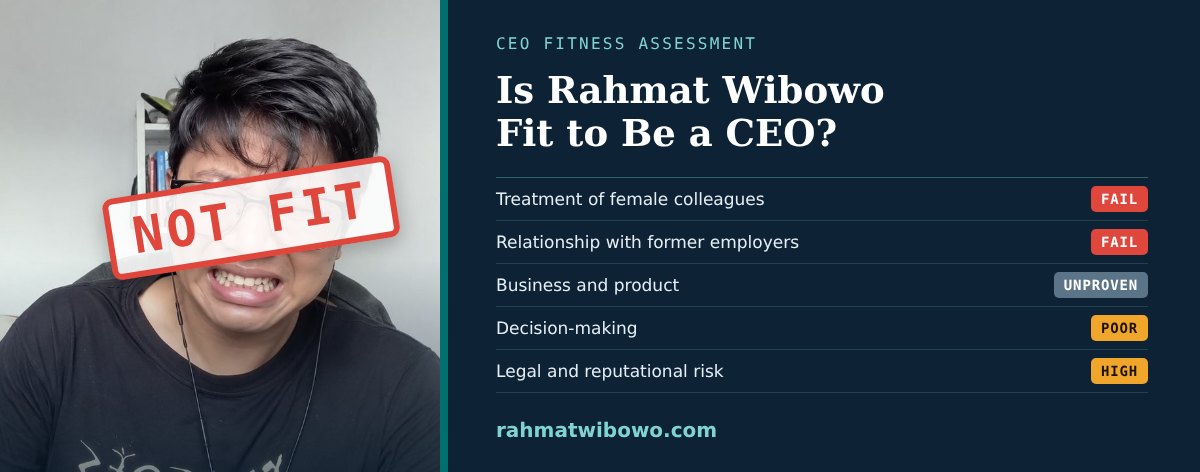
Rahmat Wibowo introduces himself as “CEO @infraloka” and an “AI Driven and Servant Leader”. He has also written a series of articles on “Phantom CEOs” (2, 3), branding young people as frauds for using the CEO title without a registered company, a product or credentials.
He is the one who decided that the CEO title should be tested. So let us test it.
The yardstick
A board or an investor assessing a CEO usually looks at a few things: how the person treats the people who work with them, how they left previous employers and partners, whether the business is real, how they make decisions, and what legal and reputational risk they bring to the company.
What we assess is what he has done, as recorded in his own posts and documents.
1. Harassment of female former colleagues
This is the heaviest mark, and at any company a record like this would be enough to stop a CEO appointment.
In September 2023, during his short time at AWS Indonesia, Rahmat Wibowo posted two Instagram Stories. The first showed the profile of a female colleague at AWS who was pregnant at the time, with her WhatsApp message reprimanding him for not yet showing he was serious, and cursed her unborn child to be born autistic, tagging AWS User Group Jakarta and Amazon Web Services. The second put up photos of four female former colleagues without their permission in a “Choose your love one” poll, asking his followers to pick one of them to love.
Three years later, what he showed was not remorse.
- He reposted both Stories, spreading the women’s photos again, and asked Meta AI to confirm they were “evidence” that he was bullied at work. Meta AI replied that the reprimand he received was ordinary work feedback.
- He acknowledged that the poll had victims, but called the video “expired” at “2.5 years” old, and said some of the victims were abroad and would hardly bother.
- When a Threads user raised it, he hid behind the presumption of innocence: “there is no history of sexual violence without a final court ruling”. He has never extended that presumption to the people he accuses.
The pattern did not stop in 2023. At AWS and at Liven, the women in HR who handled his dismissal became targets:
- Dian Hamama, Senior HR Business Partner at AWS. He reported her to the Jakarta police chief together with AWS Indonesia’s leadership, and accused her of “not understanding the law” while posting her photo.
- Dinda Rhapsodya, HR Business Partner at Liven, targeted after she complained about his behaviour. Asked in a private message whom he had threatened to kill, he replied with one word: “dinda”.
- Salsabila Meidiana Putri, HR Business Partner at Nomni (formerly Liven). He put her name on display in the negotiation minutes he posted while calling for the company to be bankrupted.
A CEO is responsible for the safety of everyone in the workplace, women above all, and for handling harassment complaints. Rahmat Wibowo is on the other side of those complaints: as the one who harassed, and as the one who strikes back at those who complain.
2. A bad relationship with almost every former employer
Rahmat Wibowo lists seven employers, Amazon Web Services, a Vietnamese company, Nomni, zvoove, Grab, Xendit and Pertamina Marine Solutions, “all by the age of 24”. He does not say how long he stayed at each. By his own account, three of them, AWS, Nomni and zvoove, let him go. All three then became adversaries.
AWS Indonesia
Less than a month into the job, he boasted on LinkedIn that his seniors had already called him in over his attitude (“udah disidang attitude wkwkkwkwk”) and that he had to “earn trust and learn to hold back at the office”. He was dismissed during probation. Three years later he is still pursuing it:
- a complaint to the South Jakarta Manpower Office, whose demands at mediation came down to whether his notice period was 7 working days or 7 calendar days;
- a complaint to the Jakarta police chief against AWS Indonesia, Country Manager Anthony Amni, Donald Tirtaatmadja and Dian Hamama;
- a vow to “bankrupt AWS Indonesia”, calling the company “stupid and idiotic” and his former colleagues the most envious;
- 16 posts in about two hours asking Meta AI why he was fired, tagging Jeff Bezos and Andy Jassy.
Liven, now Nomni (PT Nomnie Technologies Indonesia)
He announced a blacklist against Liven, accused the company of weaponising probation (2), took it to the Manpower Office together with AWS, and then called for it to be bankrupted.
zvoove (PT CreateIT Solution Indonesia)
He accused the company of ending his contract without notice and owing him payment, while complaining that its director had blocked him on LinkedIn. Days later he accused it of coordinating a reputational attack on him and questioned its legal status in Indonesia.
Always someone else’s fault
In his version, none of the dismissals had anything to do with him. The cause is always someone else: the “crab mentality” of foreign managers and HR structures, envious colleagues, or HR staff who do not understand the law.
For a CEO this matters for two reasons. First, references from previous employers are a standard part of investor and partner due diligence. Second, how a person treats the companies that let him go shows how he would treat his own employees when their employment ends: with police complaints, blacklists and calls for bankruptcy.
3. Business and product
Rahmat Wibowo has never published revenue, customer or active-user figures for InfraLoka. The measure of success he boasts about is his site’s PageSpeed score. The only documented pitch, in a Singapore investor group, ended with him being removed from the group. The Instagram account on which he calls himself “CEO @infraloka” has 25 followers.
Even the products he offers revolve around his own disputes. “SOMASI as a Service” is used most often by its own founder, to send legal notices to his critics, though a self-drafted notice without an advocate’s power of attorney is only an ordinary civil warning. His “AEGIS” business proposal offers to collect defamation fines from people who reposted posts about him, taking 5% of every fine. As far as can be seen, the business model is his personal feuds.
4. Decision-making
In under six months, by his own count, he filed 13 police reports and sent 36 complaint letters; 35 of them got no further than a receipt. He reported Meta AI to Bareskrim and sent a Rp533 million legal notice to a legal consultant over a single month-old Threads reply. A CEO has to choose his battles. Rahmat Wibowo chooses all of them.
When he needs advice, he asks Meta AI in public and then ignores the answer. After 16 posts in about two hours about his dismissal from AWS, Meta AI advised him to go straight to an advocate rather than mass-mentioning accounts. He kept tagging Meta AI and dozens of other accounts in the posts that followed (2, 3). A CEO who asks for advice and then does not listen would be hard for any board to guide.
5. Risk to the company
The legal risk is real. He was invited for clarification as the reported party in a defamation report. In the threat report Machrio Achmad Nurhatta filed against him, he did not attend the first invitation, was examined only more than two weeks later, and then complained to Propam about the investigator. A CEO who is the reported party in police cases and at odds with his own investigator is a risk that has to be disclosed to every investor.
The reputational risk is attached to the company itself. The InfraLoka blog is the source of 61 entries in our archive naming 37 different people, carrying “analyses” that defame the people he targets. His legal notices are copied to their recipients’ employers or universities. Every client, investor or employee of InfraLoka shares that risk.
6. Rahmat’s own “Phantom CEO” test
| The criteria he applies to others | His own record |
|---|---|
| Using the CEO title without a real product | “SOMASI as a Service”, with not a single customer he has ever shown |
| Fabricating authority | An “Infraloka Legal Research” letterhead on his personal complaints, “verdict predictions” under the “AEGIS” name, legal notices without an advocate’s power of attorney |
| Defrauding or failing investors | The only pitch ended with removal from the investor group |
| Misleading claims of credentials | Seven employers “all by the age of 24”, without mentioning three dismissals |
Scorecard
| Area | Assessment |
|---|---|
| Treatment of colleagues, especially women | Fail: documented harassment, with no remorse |
| Relationship with former employers | Fail: three dismissals, all three turned into disputes and calls for bankruptcy |
| Business and product | Unproven: no published revenue, customers or users |
| Decision-making | Poor: dozens of complaints that went nowhere, a legal notice for hundreds of millions over one reply |
| Legal and reputational risk | High: the reported party in police cases, the company blog used to defame |
Conclusion
On the record he has made himself, Rahmat Wibowo is not fit to lead a company. Not because of his age or his background, but because of how he has treated female colleagues, and because he has turned every employment that ended into a feud.
This assessment can change. A sincere apology to the victims of his harassment, an end to attacks on former employers and their staff, verifiable business figures and a real team would be a good start.
Rahmat Wibowo may exercise his right of reply at [email protected].